

Built for the sell side
FlowState is designed first for participants that already hold meaningful token inventory and need a better way to bring that inventory to market. That can include:- projects, foundations and treasuries
- funds, venture investors and large holders
- founders, teams and advisors
- market makers and professional traders
- trading, vesting and distribution platforms that originate sell-side inventory
- lending platforms where the relevant collateral or inventory flow fits the C1 execution model
From token inventory to market liquidity
A C1 Pool is the shared liquidity layer between concentrated token inventory and external buyer demand.1
Inventory is made available
A seller deposits only the token being offered. The position enters the per-token C1 Pool and remains withdrawable until filled.
2
The pool prices execution from the market
C1 uses an oracle-derived rate and pool protection logic rather than a bonding curve. Fill size therefore does not move the execution rate through C1 pool balances.
3
Existing execution infrastructure reaches the inventory
Aggregators, routers, intent systems, fillers, RFQ paths, direct integrations and other execution surfaces can source the same underlying C1 inventory.
4
Buyer demand consumes inventory progressively
Each fill settles atomically on-chain. A seller’s full position can complete progressively as real external demand arrives.
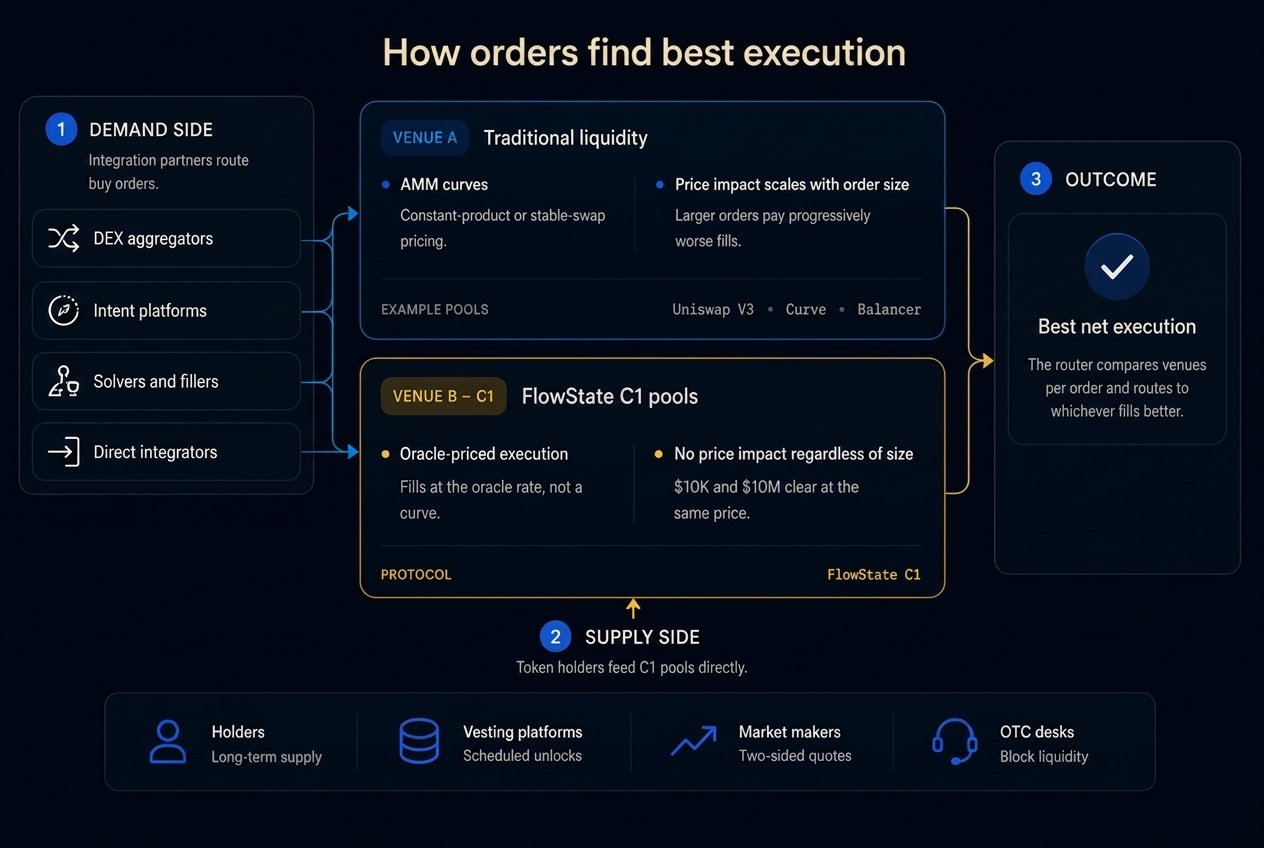
How orders find best execution
The distribution network is the moat
FlowState does not need to create a new destination and convince buyers to migrate to it. C1 inventory can be distributed through the execution infrastructure where buyer demand already exists. That matters for the sell side. More distribution surfaces increase the number of places from which buyer demand can reach C1. More professional inventory makes FlowState a more useful liquidity source for those execution partners. The network compounds around one shared inventory layer rather than creating separate liquidity silos for every integration. The buyer-side network is therefore an essential part of FlowState, but it is not the primary marketing story. The primary proposition remains simple: make difficult-to-execute token inventory available to the market through a new liquidity layer.What C1 provides
Single-sided inventory
Deposit only the token being made available for sale. No matching quote-side LP position is required from the seller.
No C1 pool-induced price impact
C1 pricing comes from an oracle-derived rate rather than the pool’s reserve curve.
Shared per-token liquidity
One C1 Pool per token can accept multiple approved quote assets and support multiple distribution paths without fragmenting the deposited inventory.
Progressive execution
Individual fills settle atomically while a larger seller position can complete over time as buyer demand arrives.
Who integrates with FlowState
Projects & Foundations
Coordinate treasury inventory, unlocks and other concentrated supply before it is forced through available market depth.
Trading Platforms
Give users with meaningful token positions an additional liquidity path alongside immediate market execution.
Vesting & Distribution
Offer recipients an optional route for unlocked inventory to become available to external demand.
Market Makers & Traders
Use C1 programmatically for inventory unwind, execution and strategy-driven flows.
Funds & Professional Holders
Make concentrated positions available progressively rather than requiring immediate full-position execution.
Routing & Intent Partners
Add C1 inventory as another execution source for existing buyer demand.
Where FlowState runs
FlowState is an EVM protocol and deployment remains pre-launch. Current staging information is published on Deployments. Production Market addresses will be published there at launch.Continue
The Liquidity Problem
Why concentrated token inventory becomes difficult to execute when trade size is large relative to available depth.
Technical Architecture
How C1 contracts, execution adapters, APIs and indexed data fit together.