

Pattern 1: Smart order router calling the Market
C1 can sit in the routing graph alongside AMMs, RFQ sources and other liquidity venues. A router discovers the per-token pool, callsquoteBuyFromPool(pool, asset, amount) for the intended quote asset and can select C1 when available inventory provides better net execution.
The quoter is a permissionless view designed to report normal route unavailability without reverting the quoting pass. An unavailable pool, paused market, unapproved quote asset or empty inventory returns available: false. If a live oracle read is unavailable but the pool has a seeded protected anchor, the quote can remain available with conservative stale-oracle treatment.
Pattern 2: Routing through Uniswap V4
The FlowState V4 hook exposes the same underlying C1 inventory through a V4 pair-shaped routing surface. The V4 representation is a distribution path, not a second source of token depth. For exact-input buys above available C1 inventory, the hook can consume only the inventory C1 can deliver and leave the unused quote input unspent. Exact-output remains all-or-nothing. A routed partial fill requires the surrounding V4 router to settle the actual live debt created by the swap rather than assuming the original maximum input was fully spent. Routers that do not support that settlement pattern revert rather than overpaying. Partner-specific compatibility should be confirmed against the current deployment before enabling routed partial fills.Pattern 3: Intent-based settlement
For intent-based execution, C1 can act as an inventory source where the token being purchased is available in a C1 Pool. A solver, filler or resolver can source that output during settlement rather than holding the token in advance.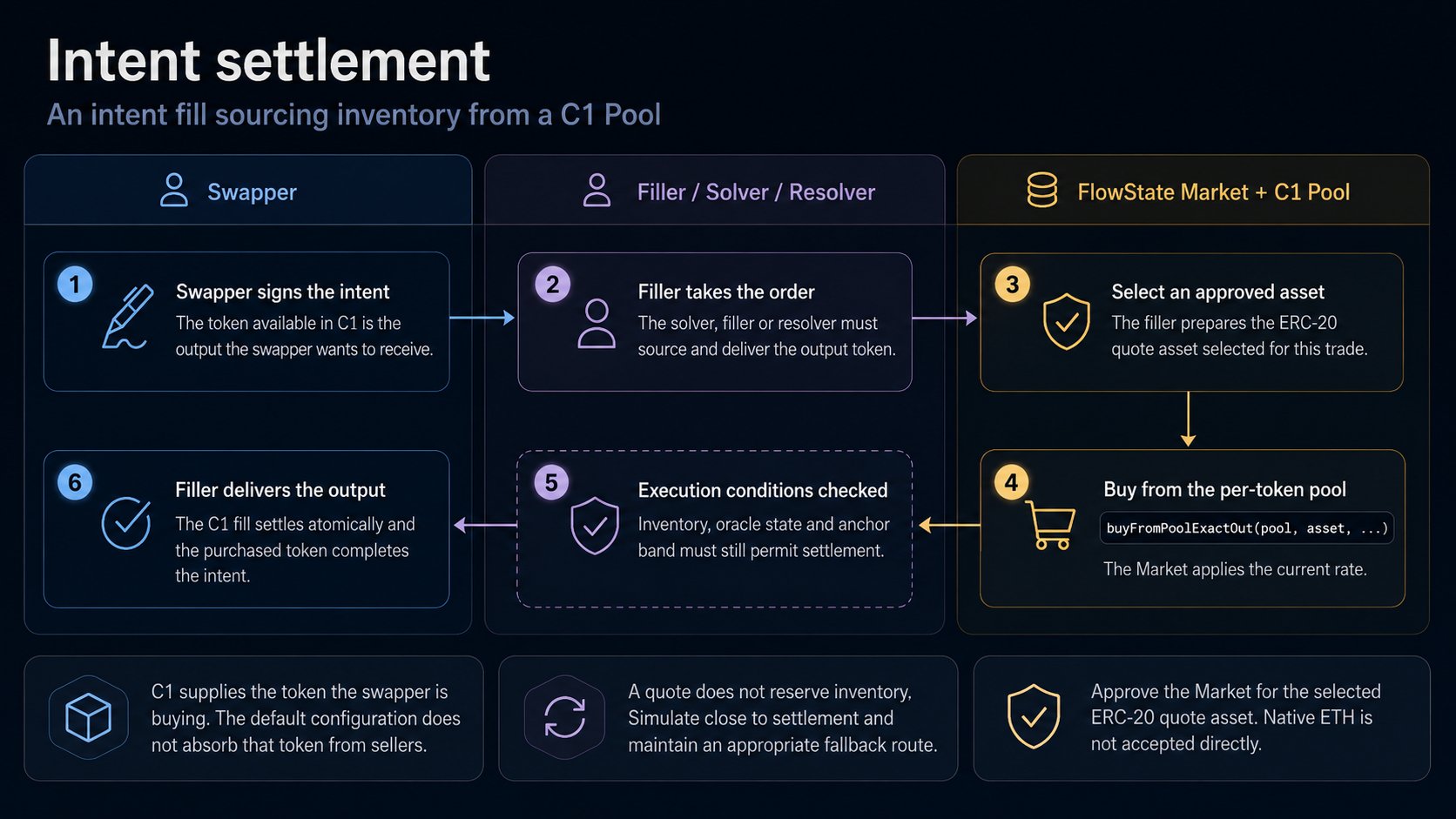
An intent fill sourcing output inventory from a C1 Pool
Pattern 4: Direct integration
Market-maker bots and other professional execution systems can call the Market directly. They use the same quote-asset-aware quoter and buy entry points, approve the Market for the selected ERC-20 quote asset and handle unavailable or rejected fills as part of their normal strategy logic.Quote versus execution
A C1 quote does not reserve inventory or guarantee later execution. Available inventory can change before settlement and oracle-derived pricing can move between blocks. Quote and execution use the same pricing path. When both are evaluated against the same block pricing state, the unit rate is consistent rather than being recalculated through a separate quote-only model. Integrators should still simulate close to execution and maintain an appropriate fallback because availability can change even when the pricing path is consistent.Choosing an entry point
Attribution
resellerCode is an optional attribution identifier used to associate settled volume with a commercial or integration partner. Commercial participation is agreed separately and is not fixed by the public interface.