

Why integrate C1 Pools
0.30% per trade, permanently
The aggregator share of the 1% seller fee is paid on every routed trade. No commercial negotiation, no decay, no incentive expiry.
Mathematically superior execution
Zero slippage means the C1 quote always wins the price comparison on supported tokens. Better user execution drives stickier users and higher volume retention.
Stack additional fees on top
Buyers receive zero slippage. An additional 0.10-0.20% aggregator margin still delivers better net execution than any AMM. C1 routing creates a revenue-stacking opportunity unique in DeFi.
No exclusivity, no relationship dependency
The C1 Pool registry is permissionless. Routing is decided by the aggregator’s own price comparison logic. The relationship is mathematical, not commercial.
How the economics compare
A typical Uniswap V3 integration earns the aggregator nothing. The 0.30% LP fee goes entirely to liquidity providers. Aggregators earn from spread capture, gas optimisation or front-end fees, not from pool routing itself. C1 Pool integration earns on both sides of the trade. The protocol pays 0.30% of every routed trade to the aggregator from the seller fee. Because buyers pay zero protocol fee and receive zero slippage, the aggregator can apply an additional 0.10-0.20% buy-side margin and still deliver better net execution than any AMM. On a $100K routed trade, that is $300 from the seller fee share plus $100-200 from the buy-side margin. Total aggregator revenue of $400-500 per execution, compounded across the volume an aggregator already routes.How integration works
1
Query the registry
C1 Pool contracts register with FlowState’s liquidity registry on each supported chain. Aggregators look up pools by token or enumerate all deployed pools on the chain. See Integration Overview.
2
Add to the routing graph
C1 Pools are added to the aggregator’s routing graph alongside AMMs, RFQ sources and other liquidity venues. The aggregator’s existing price comparison logic handles the rest.
3
Settle on-chain
When the router selects C1, settlement is atomic in the same transaction. No off-chain coordination, no signed quotes, no settlement risk.
4
Earn at settlement
The 0.30% aggregator share is distributed at settlement. No batched claims, no end-of-period reconciliation.
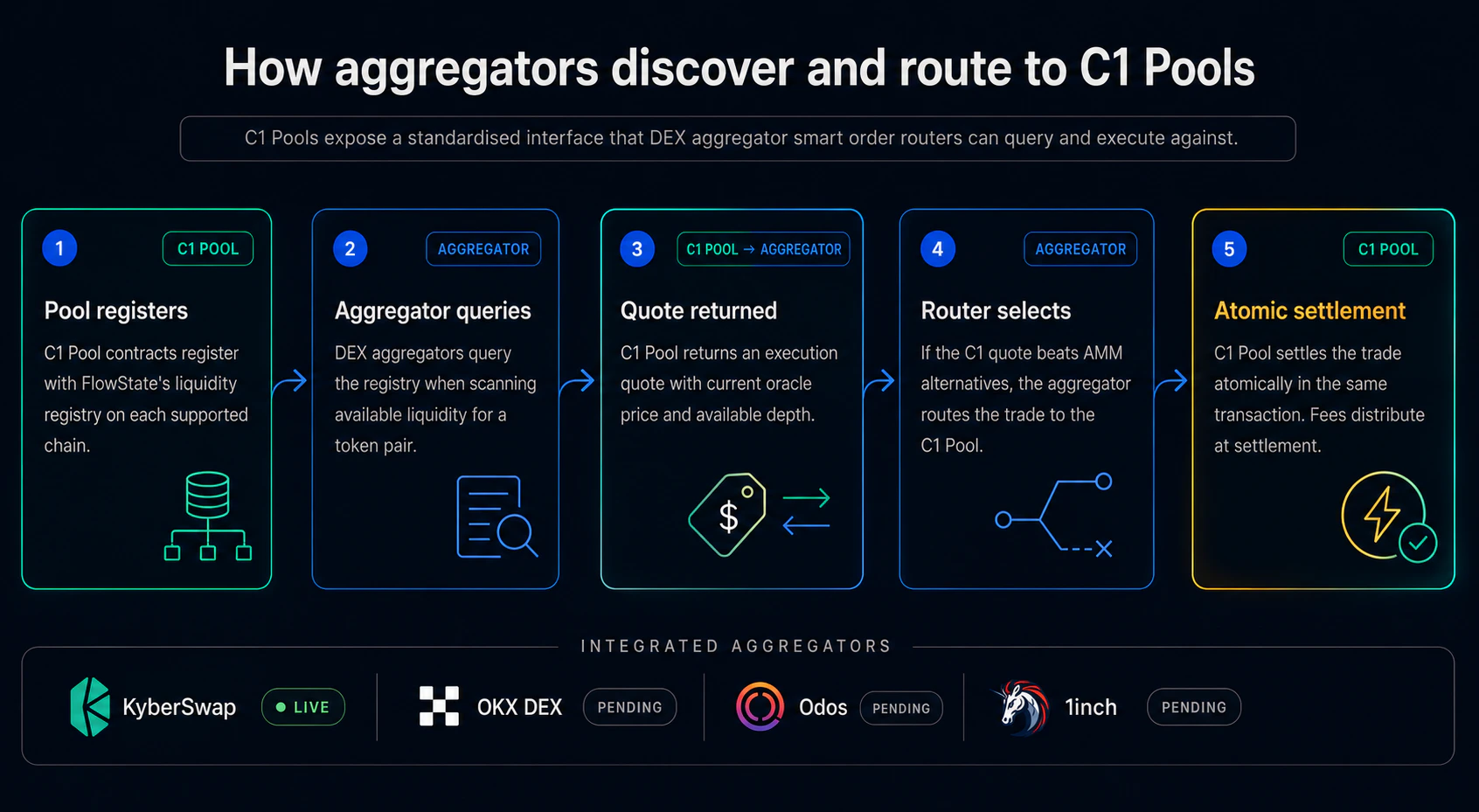
Aggregator integration sequence
Current integrations
Common questions
What if the oracle is wrong?
What if the oracle is wrong?
C1 Pools include multi-source aggregation, TWAP smoothing, circuit breakers, deposit and withdrawal rate limits and minimum oracle confidence thresholds. See Audits & Security for the full mitigation set.
What's the supported chain coverage?
What's the supported chain coverage?
Live on Ethereum, Arbitrum, Base and BNB Chain. Additional EVM chains added based on routing demand. Solana support arrives via Oasis (separate brand) on its own roadmap.
How is the 0.30% paid?
How is the 0.30% paid?
Distributed at settlement in the trade’s base currency (USDC or ETH). No claim transactions required.
What's the depth like?
What's the depth like?
Depth scales with depositor coverage per token. Aggregators that integrate early get pool growth as part of their routing improvement curve.
Get started
Integration documentation, contract addresses and a sandbox environment are available on request. Contact the integration team at partnerships@flowstate.exchange.Integration Overview
Technical detail on the registry interface, settlement flow and per-chain deployment addresses.